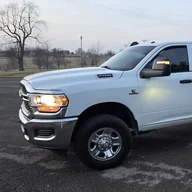

Tim says fully loaded Fathom well below mid 30's

chl

Member
First Name
CHRIS
Joined
Aug 13, 2026
Threads
0
Messages
9
Reaction score
14
Location
alexandria virginia
Vehicles
2023 LIGHTNING PRO, 2012 Nissan Leaf, 2015 Toyota Prius, 2000 HD 883 Sportster
Country flag
As for the price estimates and comparisons...usually dealers and companies refer to the MSRP.

The MSRP on my stickers always included destination and delivery charges ($1995 for my Lightning I have seen $1595 for the Fathom quoted).

But state sales taxes and fee vary among the states, obviously, so I'd exclude those from a general discussion of price.

What we know:

Ford says Fathom will have a starting MSRP of $28,350 before a $1,595 destination and delivery charge. ($29,945 with)

Exact ER battery pricing is pending, but Ford confirmed it will cost "significantly less" than the F-150 Lightning $10k option.

So I'd agree that means under $5,000 additional.

In late 2026: "Official vehicle photography, interior views, range estimates, and trim specifications are released."

Ford says the base trim will not include the 300 mile ER battery.

"We've talked about at least having two batteries, and so we're going to have a smaller battery for the base vehicle. And we think that there's a lot of people who have already owned EVs now, millions of people who have already owned EVs, and some of them are realizing that they want a two-solution household, of which one is their long-distance road trip car and one is their commuter that does 99% of what they need," Alan Clarke, vice president of advanced development projects at Ford, told GreenCars in a recent interview, when asked if the base Fathom will have 300 miles of range.

https://fordauthority.com/2026/08/28k-ford-fathom-will-not-include-300-mile-extended-range-battery/


The all-wheel drive adds a front motor and whatever overhead goes into that.

I could see that adding maybe $1500 to the MSRP.

So base price $29945 + ER $5000 + AWD $1500 = no more than $36 445 by my guess-timate worst case scenario.

FWIW
 

mark

Active Member
First Name
Mark
Joined
Aug 6, 2026
Threads
2
Messages
41
Reaction score
47
Location
florida
Vehicles
Escape
Country flag
It all depends on how well they did with the aerodynamics at reducing drag and weight reductions (using less copper etc) in their UEV platform design.

Aerodynamics is more important than weight wrt efficiency at highway speeds (over 50 mph).

Drag increases exponentially with speed, especially at highway speeds this becomes the critical factor.

Weight is more important at slower speeds, stop and go driving especially - some of the energy used to accelerate is recaptured with regenerative braking in EVs and hybrids however.

The EPA estimates use a combination of highway and city driving to produce their estimated range.

In my 2021 Nissan Leaf I average 4.8 m/kWh with mostly below 45 mph driving (city driving).
It weighs about 3,400lbs.
I don't know for sure what the drag coefficient is, but I have seen numbers between 0.29 and 0.32.
The EPA estimate was only about 2 mi/kWh, for combined city and highway driving.

Ford is aiming to improve the cd of the Fathom by 15% over other EV pick-up trucks, but haven;t released a number yet (if they have I missed it). The others are in the neighborhood of 0.30. That would mean they are aiming for about 0.23, which would be BETTER than the official number for my 2012 Leaf.

We also do not know the official weight number.

They reduced over 20lbs of weight with their copper-efficient design, and will be using aluminum unicastings which Ford said would reduce the weight compared to other EV pickups by about 27%.

The Rivian RT1 s about 7,000 lbs so Ford is aiming for a weight of around 5,000lbs.

So, imagine a truck with a weight of around 5,000lbs and a cd of 0.23 and compare it to the Lightning.

Mine weights 6,000lbs and the cd is 0.43 (based on testing results found on-line).

That points to a much more efficient truck both highway and city driving.

If anyone wants to do the estimate using those or other numbers, that might be interesting.

You'd also need the rolling resistance of the tires which is typically 0.01 to 0.05 for low-resistance EV tires.
Drive train efficiency is another factor, but assume 90% (the approx. number for the Lightning).

Then: energy used in kWh/mile is (rolling resistance energy + aerodynamic drag energy) / drive train efficiency.

A rule of thumb for rolling resistance energy in Wh/mile is weight x 0.045
The drag energy depends on/varies with speed, and uses the air density, frontal area, and cd in the equation, so there is no basic rule of thumb for that.

If we had some numbers or estimate, we could use something like this on-line spread-sheet range calculator:


Or we can wait for Ford and the EPA to tell us! :)
Nice post. Good engineering approach. E=MVsquared! Never thought about it like that. Helps me rationalize the Ford approach for getting performance. I will wait for Ford to tell us! Also asked Riley about protection from water to the undercarriage batteries and motors. You may have some knowledge on how EV’s protect their electrical components snce you have the Leaf. This will be my first EV.
 
Last edited:

WXman

Well-Known Member
Joined
Jul 23, 2026
Threads
1
Messages
75
Reaction score
93
Location
Kentucky
Vehicles
2024 Ram 2500 Cummins - 2025 Jeep Wrangler Rubicon
Country flag
In terms of aero, I can't imagine that Fathom has better drag coefficient than Mach-E which is essentially bubble/tear drop shaped. And we know Mach-E generally nets about 3.0 mi/kWh on average if you talk to a bunch of owners.

I'd say with a little bitty 57 kW pack, 200 miles in a Fathom will require ideal weather, only the driver in the cab, and within the speed limits.
 

chl

Member
First Name
CHRIS
Joined
Aug 13, 2026
Threads
0
Messages
9
Reaction score
14
Location
alexandria virginia
Vehicles
2023 LIGHTNING PRO, 2012 Nissan Leaf, 2015 Toyota Prius, 2000 HD 883 Sportster
Country flag
Nice post. Good engineering approach. E=MVsquared! Never thought about it like that. Helps merationalize the Ford approach for getting performance. I will wait for Ford to tell us! Also asked Riley about pretection from water to the undercarriage batteries and motors. You may have some knowledge on how EV’s protect their electrical components snce you have the LEaf. This will be my first EV.
Congratulations in advance on owning an EV!

The Leaf was way better protected than my 2023 Lightning Pro underneath.

Lightning owners have had quite a few issues in that dept., from rodents or raccoons getting in and setting up shop chewing on wires or doing other havoc, to road debris breaking connectors or wires, even one case where a stick somehow broke a cooling line nipple to the HVB pack!

People regularly spray Critter Ridder or other things to discourage them - the squirrels don't seem to be bothered by it however.

Most recently a tire blow out took out someone's PPOB (pro power on board 240VAC) - the bed wiring for the outlet is nearby and got damaged by a steel belt off the tire.

Hope they did a better job on the Fathom!
 

chl

Member
First Name
CHRIS
Joined
Aug 13, 2026
Threads
0
Messages
9
Reaction score
14
Location
alexandria virginia
Vehicles
2023 LIGHTNING PRO, 2012 Nissan Leaf, 2015 Toyota Prius, 2000 HD 883 Sportster
Country flag
In terms of aero, I can't imagine that Fathom has better drag coefficient than Mach-E which is essentially bubble/tear drop shaped. And we know Mach-E generally nets about 3.0 mi/kWh on average if you talk to a bunch of owners.

I'd say with a little bitty 57 kW pack, 200 miles in a Fathom will require ideal weather, only the driver in the cab, and within the speed limits.
I hear ya, time will tell if they meet or exceed 3.5 miles/kWh, and the exact kWh battery size.
I think it is doable based on engineering possibilities.

For an example of what can be done with range by minimizing drag, look at the Aptera (soon to be in production).


chl

Member
First Name
CHRIS
Joined
Aug 13, 2026
Threads
0
Messages
9
Reaction score
14
Location
alexandria virginia
Vehicles
2023 LIGHTNING PRO, 2012 Nissan Leaf, 2015 Toyota Prius, 2000 HD 883 Sportster
Country flag
In terms of aero, I can't imagine that Fathom has better drag coefficient than Mach-E which is essentially bubble/tear drop shaped. And we know Mach-E generally nets about 3.0 mi/kWh on average if you talk to a bunch of owners.

I'd say with a little bitty 57 kW pack, 200 miles in a Fathom will require ideal weather, only the driver in the cab, and within the speed limits.
If the numbers I saw are correct, the dc is about .3 for the Mach-e. which is comparable to my Leaf official number.

Ford has said they are shooting for around .23 (using their goal of 27% better than competing EV trucks) so highway driving should be more efficient than the Mach-e if they meet that goal.

We don't know the exact weight yet to compare that with the Mach-e, or what the tires will be for calculating rolling resistance (the main issue at non-highway speeds). The Mach-e seems to max out at around 5,000 lbs.

They say the Fathom will be 'significantly' lighter than the Lightning - my 2023 Pro weighs around 6,000 lbs.

Maybe the Fathom will weigh less than the Mach-e? With the reductions in wiring due to the 48V design and other ground-up features, it is possible.
 

graycorgi

Member
Joined
Jun 16, 2026
Threads
0
Messages
18
Reaction score
33
Location
East TN
Vehicles
'22 Kia EV6
Country flag
With the reductions in wiring due to the 48V design and other ground-up features, it is possible.
I wonder how much added weight is caused by the 400v wiring vs 800v. Lower voltage = higher amperage = needs thicker wiring.
 
OP
OP

onuiebvbevnulib

Well-Known Member
First Name
Steve
Joined
Feb 25, 2026
Threads
9
Messages
70
Reaction score
69
Location
Coppell, TX
Vehicles
2023 Ford Maverick XLT Hybrid
Country flag
I wonder how much added weight is caused by the 400v wiring vs 800v. Lower voltage = higher amperage = needs thicker wiring.
Manufacturing an 800-volt electric vehicle architecture generally increases OEM component and overall system costs by about 20% to 30% compared to a standard 400-volt system.

Cost Breakdown: 400V vs. 800V
  • Semiconductors: 800V systems require advanced silicon carbide (SiC) power semiconductors and inverters instead of standard silicon chips. These components handle high voltages more efficiently but carry a significantly higher price tag.
  • Insulation and Safety: Higher operating voltages demand stricter insulation standards, specialized connectors, robust contactor ratings, and sophisticated thermal management designs, raising the vehicle's overall bill of materials (BOM).
  • Supply Chain Scale: 400V architectures benefit from mature, high-volume supply chains and long-standing economies of scale. 800V hardware remains newer and less mass-produced, keeping component costs elevated.
  • Wiring Savings: 800V systems allow for lower electrical current at equivalent power outputs. This cuts copper usage, reduces wiring harness weight, and provides minor material cost offsets, though these savings do not fully offset the expensive power electronics
 
 
Top